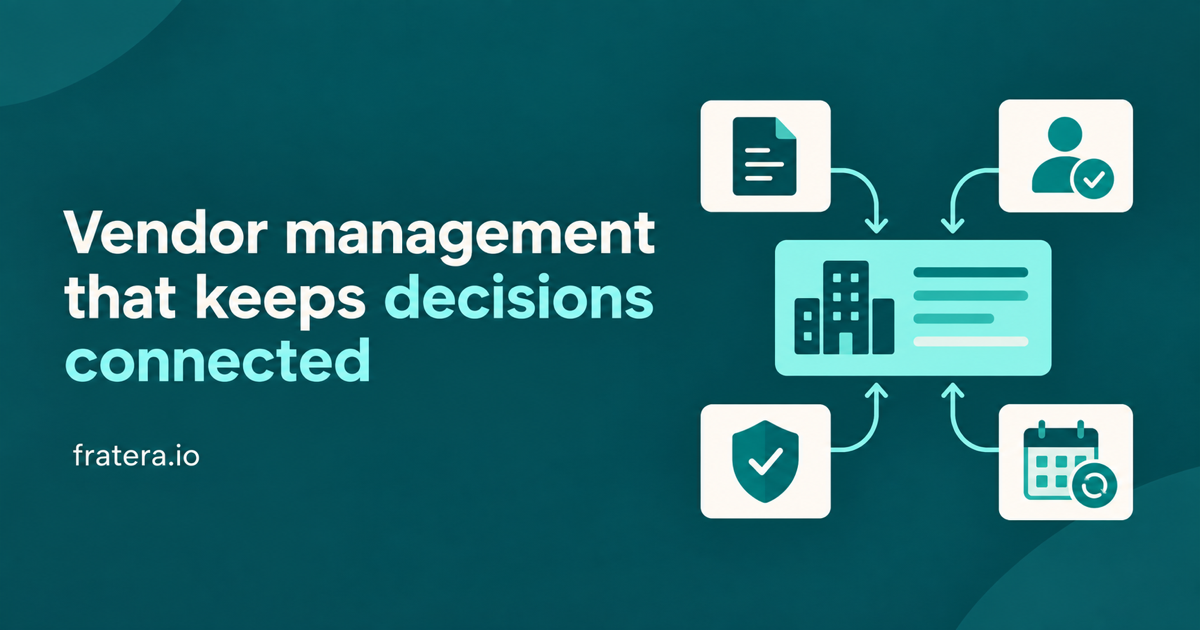
A supplier relationship rarely fails because a team lacked a spreadsheet. It fails because the spreadsheet did not show who owned the relationship, what the contract required, which assessment was approved, or when notice had to be given. Effective vendor management turns those disconnected facts into an operating system for decisions.
For procurement teams managing a growing supplier portfolio, the goal is not simply to maintain a vendor list. The goal is to know your commitments, assign accountability, preserve evidence, and act before a commercial or risk deadline closes. That requires supplier data and contract data to remain connected from the first request through renewal, termination, or replacement.
Vendor Management Is an Accountability System
Vendor management is the structured process of selecting, assessing, approving, contracting with, monitoring, and renewing suppliers. In practice, it coordinates procurement, legal, finance, security, business owners, and supplier contacts around one shared record of the relationship.
That definition matters because many organizations treat supplier management as a collection of administrative tasks. A vendor is added to a directory. A contract is stored in a drive. Security sends a questionnaire by email. Finance approves a purchase order in another system. When renewal approaches, someone searches inboxes and asks whether the supplier is still being used.
Each action may be reasonable on its own. Together, they create an accountability gap. The supplier record has no clear connection to the agreement. The agreement has no accountable business owner. The approval trail is difficult to retrieve. A risk review exists, but no one knows whether it applies to the current service scope.
A connected approach answers practical questions quickly: Who owns this supplier? What are we committed to spend? Which services are covered? What did security approve? Can we renew under the existing authority? Is our exit window approaching?
What a Complete Supplier Record Should Show
A vendor record should provide context, not just contact details. At minimum, procurement needs a reliable view of the supplier entity, relationship owners, active and historical agreements, commercial commitments, risk status, reviews, and upcoming milestones.
The contract is central, but it is not the whole picture. A signed agreement tells you the negotiated terms at a point in time. Day-to-day management also depends on amendments, statements of work, renewal notices, insurance certificates, data processing terms, security assessments, and performance reviews. When these are scattered across folders and mailboxes, teams spend time reconstructing the relationship instead of managing it.
The same principle applies to ownership. Procurement may own the process, while a business leader owns service outcomes, IT owns technical integration, security owns due diligence, and finance owns budget approval. Vendor management should make those responsibilities explicit. A named owner is useful only if that person has the context and timely prompts needed to act.
Keep supplier and contract records connected
Separate supplier and contract repositories create predictable problems. A contract manager may see a renewal date but not know whether the supplier has an unresolved risk finding. A vendor manager may see an assessment result but not know which agreement or business unit it supports. A finance approver may see a renewal request without the current spend commitment or prior approval record.
Connecting records changes the quality of the decision. Instead of asking people to assemble evidence manually, the system presents the relevant supplier, agreement, workflow history, documents, and owners together. This does not remove judgment. It gives the people making the judgment a dependable starting point.
Build the Process Around Decisions, Not Documents
Documents matter because they provide evidence. But a document repository alone does not manage a supplier relationship. The process should be designed around the decisions the organization needs to make and the evidence required for each one.
For a new supplier, the sequence is often clear: request, assess, approve, contract, sign, and activate. The detail varies by supplier type, spend level, data access, geography, and criticality. A low-risk professional service provider should not follow the same review path as a supplier processing customer data or supporting a critical business operation.
Configurable workflows make that distinction practical. They route the right request to the right reviewers, collect assessments and documents, apply delegation-of-authority controls, and preserve the decision trail. The objective is not to add gates for their own sake. It is to ensure that higher-risk or higher-value commitments receive the level of scrutiny they require.
A well-designed workflow should answer four questions at every stage: what decision is being requested, who is accountable for it, what evidence supports it, and what happens next. If a request cannot answer those questions, it is not ready for approval.
Approval routing needs clear authority
Approval bottlenecks are often described as a speed problem. More often, they are an ownership problem. Requests stall when approvers do not know why they were included, whether they have authority, or what they are expected to review.
Delegation-of-authority rules reduce ambiguity. They can route decisions based on spend, commitment term, supplier category, risk rating, or business unit. They also support continuity when an approver is unavailable. The important control is not merely that an approval occurred, but that it occurred through the right authority path and remains available for audit.
Renewal Management Starts Before the Renewal Date
Renewals are where fragmented vendor management becomes expensive. Missing a notice deadline can trigger an unwanted extension, reduce negotiating leverage, or leave a business dependent on a supplier without a current review. The reminder to act cannot begin on the contract end date. By then, the meaningful decision may already be made for you.
Start with the contract terms: notice period, auto-renewal language, pricing changes, termination rights, renewal options, and any required review commitments. Then work backward to define a decision window. For a material supplier, that window may need to begin months before notice is due, particularly if replacement would require sourcing, implementation, data migration, or regulatory review.
The business owner should not receive a generic reminder that a contract is expiring. They need a directed decision: renew, renegotiate, issue notice, or replace. Procurement needs the commercial context. Legal needs the governing agreement and amendments. Security may need a reassessment. Finance needs budget visibility. A connected record lets each stakeholder work from the same facts.
This is where contract intelligence can help, provided the answer remains grounded in the source document. AI-generated summaries are useful for finding relevant clauses and answering routine questions, but procurement teams should be able to see the cited agreement language behind the answer. Evidence-backed assistance is faster than manual searching and safer than unsupported interpretation.
Measure What Helps Teams Act
Vendor management metrics should reveal where action is needed, not create reporting for its own sake. The most useful measures usually reflect ownership, timeliness, and exposure.
For example, track contracts with no named business owner, suppliers with overdue assessments, upcoming notice deadlines without a documented decision, agreements outside approved authority, and critical vendors without a recent review. These measures identify control gaps before they become urgent incidents.
Spend visibility also matters, but it needs context. Total spend with a supplier is less useful if it cannot be connected to active contracts, committed terms, and the business services being delivered. A relationship may be low spend but operationally critical. Another may be high spend but easily replaceable. Risk and criticality should shape the management approach.
Avoid Two Common Extremes
Some teams manage vendors through spreadsheets, inboxes, and shared drives until the portfolio becomes unmanageable. Others respond by buying separate tools for contracts, supplier information, assessments, approvals, signatures, and renewals. The first approach lacks control. The second can create a new layer of integration work and duplicate records.
The better path is proportionate governance in a connected workspace. Smaller teams do not need an overengineered program, but they do need a reliable system of record. Larger teams need deeper workflow configuration, role-based access, audit history, and data controls. Both need the same foundation: decisions, evidence, and commitments connected to the relevant supplier and agreement.
Fratera is built around that foundation, bringing vendor records, contracts, approvals, assessments, e-signing, renewal actions, and document-cited AI answers into one procurement workspace. Each customer operates in its own database, supporting a clearer boundary for data ownership and security.
The practical test is simple. When a stakeholder asks about a supplier, your team should not have to open five systems and search three inboxes. You should be able to see the relationship, understand the commitment, identify the accountable owner, and decide what needs to happen next—before the deadline decides for you.
Vendor management in Fratera