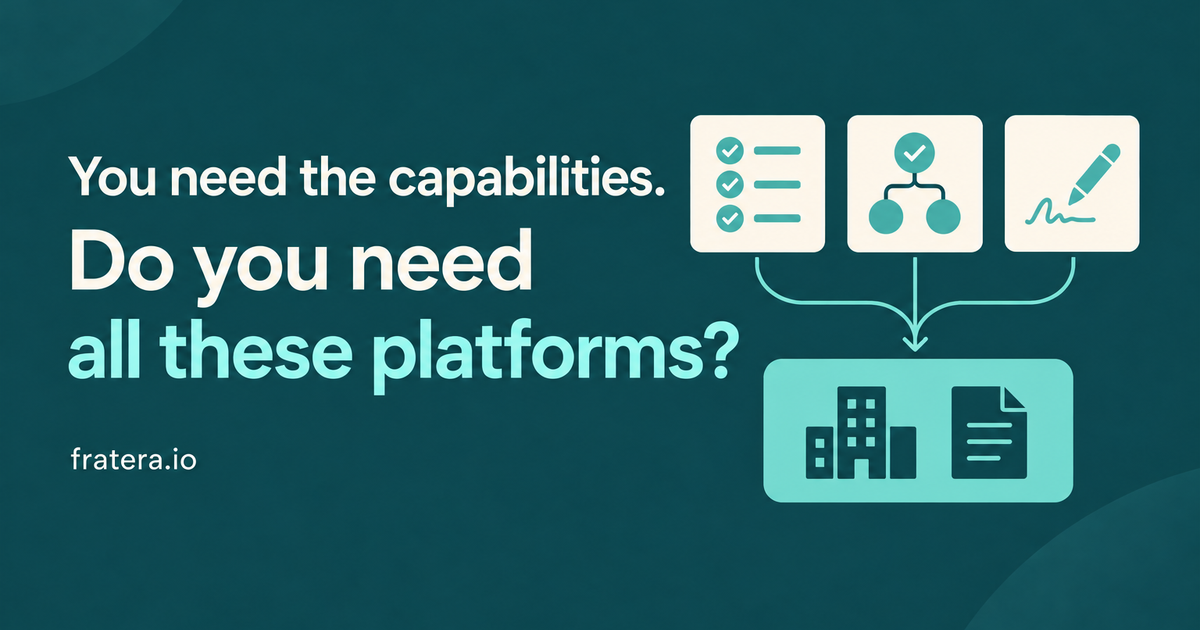
There’s a purchasing decision worth questioning: when we need assessment, workflow and signing capabilities, do we automatically need a separate platform for each?
Take bringing on a new supplier:
- You want to ask some questions before committing. Depending on the supplier, that could cover insurance, information security, business continuity or how they handle your data. Someone needs to review the answers and follow up where necessary.
- The contract then needs approval. Perhaps the business owner confirms the scope, finance checks the commitment, and someone with the right authority gives the go-ahead.
- Finally, it needs signing.
None of this is unusual. Yet it can lead an organisation towards an assessment platform, a workflow platform and a signing platform—alongside wherever it already keeps its suppliers and contracts.
Each product may be very good. Each may also offer considerably more than the organisation needs. The assessment platform might support complex assurance programmes when the immediate requirement is a questionnaire, evidence and a recorded review. The workflow platform might offer extensive automation when the team needs a clear route through a few responsible people. The signing platform might have a long list of capabilities that rarely feature in the agreements being signed.
Buying that additional depth can be the right decision in some cases, but is this the case for you? Every system requires management, scrutiny, monitoring. Every system comes with a price tag covering the same essential costs to operate and profit margins for every supplier involved.
There is also the work between the systems to consider.
Does someone create the supplier three times? Can the approver see the assessment, or just a link they may not have access to? Does the signed agreement find its way back to the supplier record? When ownership changes, can the next person understand what happened?
Those details deserve a place in the buying decision, alongside the feature comparison.
This is the thinking behind Fratera.
We put the supplier and contract foundation first. The records, the people responsible, the agreements and the dates that need attention. Then we bring assessment, workflow and signing capabilities around that foundation.
An assessment belongs to the supplier you are considering. An approval belongs to the request or agreement being reviewed. The signed document belongs with the contract you will continue managing. AI can be used to speed up process steps, but will always remain a servant to you, not become your master.
We’re not claiming to replace every specialist platform in every situation, but a team should also have the option to get the capabilities it needs without assembling and maintaining a collection of separate products.
For us, that means taking the foundation seriously and making the surrounding essentials useful enough to handle real work.
Before buying the next platform, it’s worth writing down the actual process you need to complete—including what happens before and after that platform does its part. That often makes the requirements much clearer.
The foundation and the essentials