
Procurement teams rarely struggle because they have no way to send a questionnaire, compare prices or store a contract. The more persistent problem is keeping those activities connected as a commercial decision develops. Requirements change during an RFP. A supplier’s answer raises a concern that needs specialist assessment. Negotiations produce a different scope from the one originally evaluated. By the time an agreement reaches approval, someone has to reconstruct what changed, which evidence remains relevant and whether the final commitment reflects the decision the business intended to make.
Sourcing and negotiation orchestration is the next direction for Fratera. We are designing an engagement workspace that brings these activities together around a shared business objective and the suppliers involved. It builds on our workflow foundation and extends the connection between supplier records, assessments, approvals and contracts into the work that precedes an agreement. The ambition is to make Fratera a supplier-centered procurement workspace: a place to coordinate a commercial engagement, understand how its decisions were reached and carry that context into the ongoing relationship.
Why a fixed sourcing sequence is not enough
A conventional process might move from demand to RFI, RFP, evaluation, negotiation and contract. That sequence is useful as a starting point, but it does not describe every engagement. A renewal may begin directly with negotiation because the supplier and service are already established. An unfamiliar market may require an RFI before the business can write a meaningful specification. A security assessment may be needed before shortlisting, while a more detailed implementation review only becomes worthwhile once a preferred supplier emerges.
The difficulty is not simply that teams need different templates. The route can change after work has started. Suppose a supplier proposes a lower-cost service model during negotiation, but that model changes where data is processed. The commercial opportunity now requires another privacy review. The team should be able to add that review, connect it to the revised proposal and make the relevant decision depend on its outcome. It should not have to restart the sourcing exercise or manage the new requirement in an unconnected email thread.
This is the purpose of the planned engagement canvas. Users will be able to start with the activity they need, add further work as the engagement develops and connect activities through relevant information and explicit prerequisites. Flexibility concerns the route through the work, not the removal of governance. Starting with a negotiation must not bypass the approvals needed to make the resulting commitment.
What an orchestrated engagement looks like
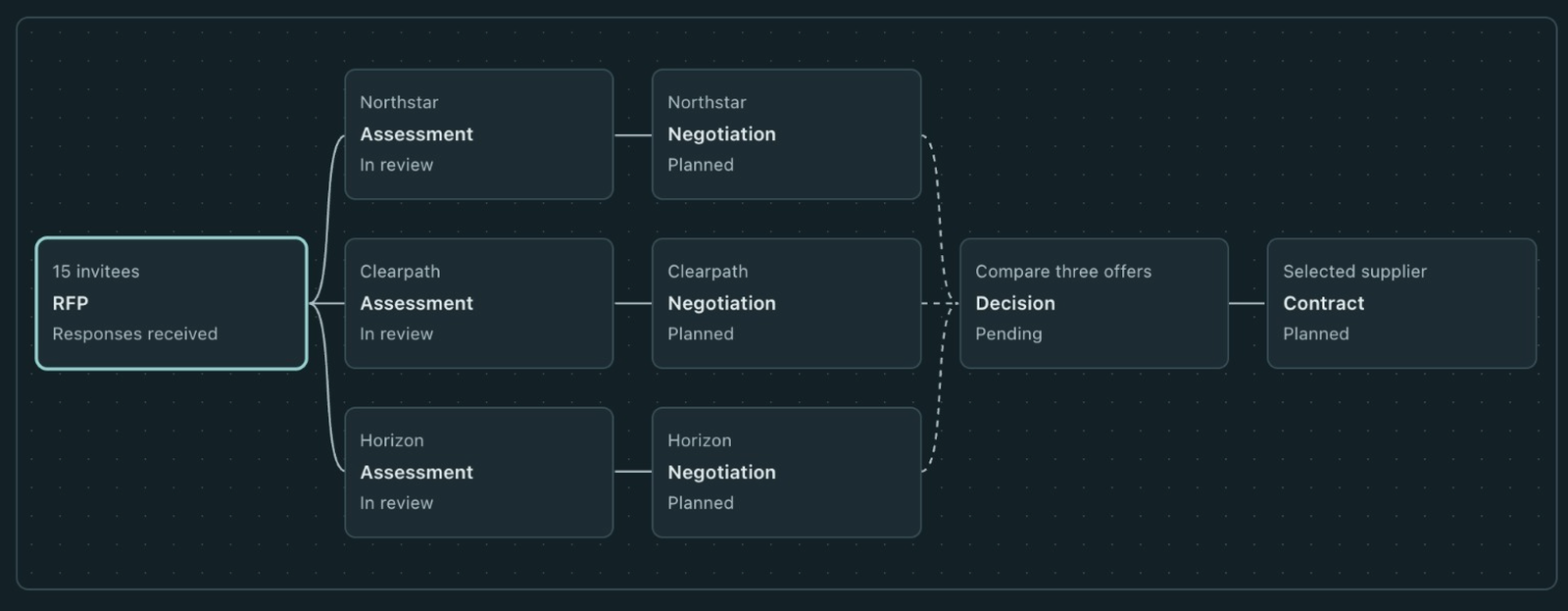
Consider a business selecting a new software provider. An RFP goes to fifteen suppliers, with questions covering functionality, implementation, support, security and commercial terms. After an initial evaluation, three suppliers remain credible contenders. At that point, the team may need three separate assessment tracks and three separate negotiations—not one generic “assessment complete” checkbox followed by one “negotiation” stage.
Those tracks will not necessarily progress together. One supplier may have acceptable security evidence but an unresolved liability position. Another may offer attractive pricing but require clarification of implementation responsibilities. A third may need to demonstrate that a mandatory integration is feasible. The engagement should make these differences visible, allow the appropriate people to work on them and show which unresolved matters stand between each offer and a decision.
In the proposed canvas, each activity provides an entry point into that work. The overview stays focused on ownership, status and dependencies; detailed responses, documents, evaluation and discussion sit inside the relevant activity. This separation matters because a canvas that displays everything quickly becomes another source of administrative noise. Its value is helping a procurement lead understand the engagement without requiring every specialist to work through every other specialist’s detail.
Carrying context forward requires more than connecting boxes
A line between two activities is only useful if people understand what follows it. Some connections provide context: an assessment may use a supplier’s RFP response as an input. Others establish a prerequisite: a final approval may require a particular review to have reached an acceptable outcome. These are different relationships. “The assessment has finished” does not necessarily mean “the supplier has passed,” and neither statement automatically authorizes a contract.
The design therefore treats information continuity as more than copying fields. Teams need to know which response, proposal or assessment informed a decision. If a supplier changes an offer after evaluation, that change should be identifiable rather than silently replacing the position people reviewed. Similarly, the commercial terms of competing suppliers must remain separate even when their results are brought into a common comparison.
This becomes especially important at the handoff to contracting. The person preparing an agreement needs the selected commercial position, relevant conditions and outstanding requirements—not merely a notification that a supplier won. An assessment finding may require a contractual commitment, while a negotiated concession may depend on a particular term length or implementation scope. Keeping that context connected helps the team check whether the agreement being approved actually represents the deal it intended to make.
Reusable RFP content, with accountable evaluation
Orchestration will not be useful if the activities inside it remain cumbersome. Preparing a substantial RFP often means working with hundreds of questions contributed by different functions. Much of that content is reusable, but repeatedly copying old questionnaires creates its own problems: duplicate questions, obsolete requirements, inconsistent wording and sections that no longer fit the purchase.
Our planned question-pack gallery addresses this at a practical level. Teams will be able to assemble an RFP from smaller reusable packs—for example, supplier essentials, SaaS commercial terms, support arrangements, implementation, security or references—then review and adapt the assembled content for the specific event. The distinction between reusable library content and the questionnaire issued to suppliers is important. A change made for one engagement should not inadvertently rewrite the standard questions used elsewhere or alter the historical record of an earlier event.
Evaluation needs similar care. Security, finance, the business and procurement may review different sections, with several evaluators and commenters contributing to each. Preliminary weightings and responsibilities need to be configurable, while the basis used for an issued event needs to remain clear. A final moderator is central to the design: someone must resolve disagreements and take responsibility for the final evaluation. That moderated result should sit alongside the original contributions, not erase them. Evaluation sign-off, supplier selection and contract approval also remain distinct decisions, even where the same person participates in more than one.
Comparison should expose uncertainty, not conceal it
With fifteen contenders, a comparison table can become too large to support useful judgment. The planned approach is to let teams work from section-level comparisons and heatmaps, then inspect individual questions, evidence or selected suppliers where the differences matter. Structured answers can make initial evaluation faster, but a yes/no response is only useful when the requirement is clear and the supporting evidence is adequate. Complex commercial or operational questions still need explanation.
Showstoppers require particular discipline. A supplier with a high weighted score may still fail a mandatory requirement. A supplier with no confirmed failures may simply have unanswered or unverified requirements. For that reason, the design distinguishes confirmed blockers from unresolved showstopper questions rather than presenting both as a single score. Where an exception is accepted, the rationale and authority for accepting it should remain visible; the underlying failure should not be relabeled as compliance.
Supplier clarification also belongs within the engagement. A question may need buyer triage, specialist input and approval before an answer is published. If that answer materially changes the requirement, it becomes a change to the event—not just another message. Connecting clarification to the questionnaire and evaluation helps preserve a fair, understandable basis for comparison.
A broader procurement workspace, without claiming to be everything
This direction expands Fratera’s role, but it is not a claim to reproduce every component of a comprehensive source-to-pay suite. Specialist sourcing depth, purchasing transactions, invoice processing and payment operations are substantial disciplines in their own right. Our focus here is the connected work around supplier selection, negotiation, governance and the resulting relationship.
That focus matters because the relationship continues long after the sourcing event closes. The reasons for choosing a supplier, the risks accepted, the commitments negotiated and the conditions attached to approval may all become relevant during delivery reviews, amendments or renewal. If they remain isolated in a completed sourcing project, the next team starts by reconstructing history. If they remain connected to the supplier and its agreements, they provide a usable starting point for the next decision.
Sourcing and negotiation orchestration is coming soon to Fratera. We are building towards a workspace where teams can adapt the process as they learn, retain control over the decisions that matter and manage the supplier relationship with the context those decisions created.
Coming soon