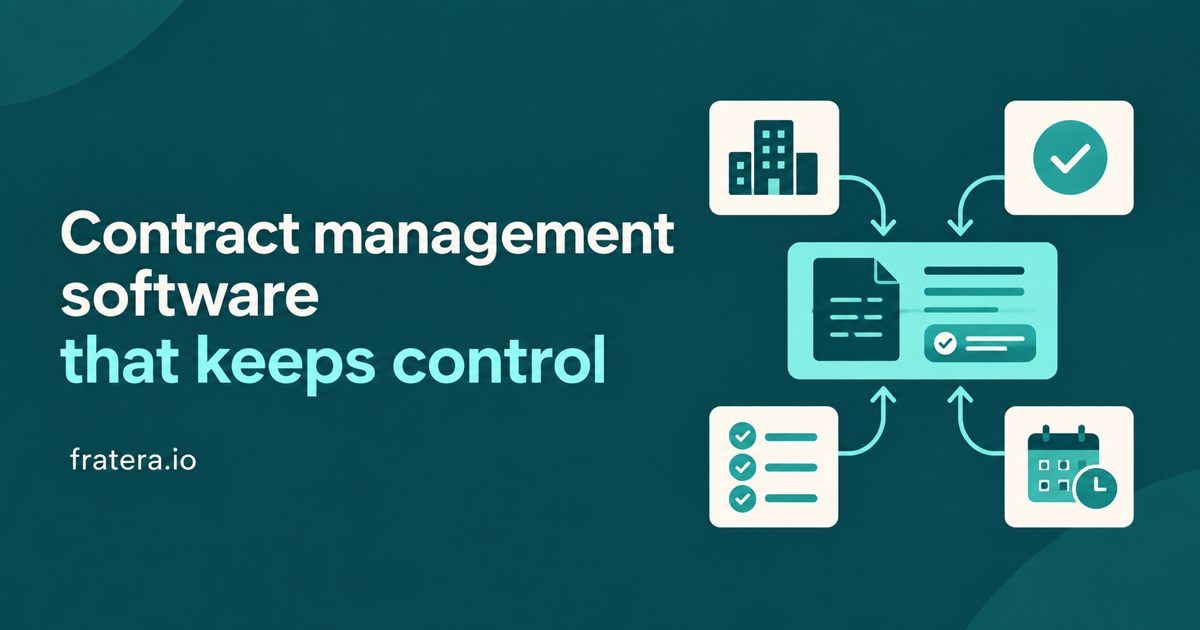
A renewal notice period can expire quietly while the contract owner changes roles, legal comments sit in an inbox, and procurement works from an outdated spreadsheet. The issue is rarely that a team lacks a signed agreement. It is that the agreement, supplier record, approval history, commercial terms, and next decision are stored in different places. Contract management software should bring those facts together and make ownership visible before a deadline becomes a problem.
For procurement teams managing a growing supplier portfolio, this is not simply a document-storage requirement. It is an operating model requirement. Teams need to know what they have committed to, who is accountable, what evidence supports a decision, and when action is required.
What contract management software should control
At its most basic, contract management software stores agreements and makes them searchable. That is useful, but insufficient for enterprise procurement. A signed PDF does not explain whether the supplier completed due diligence, which business owner accepted the commercial terms, whether spend was approved within delegation-of-authority limits, or whether an amendment changed the renewal date.
A useful system establishes a connected record around each supplier and agreement. The contract remains tied to its amendments, notice period, key obligations, owners, approval trail, risk reviews, and supporting documents. When someone asks, “What are we committed to with this vendor?” the answer should not require a hunt through folders, email threads, and separate vendor tools.
This connection matters most when conditions change. A business owner may request a renewal, finance may question a price increase, security may require a fresh assessment, and legal may flag a non-standard limitation of liability. Those are not disconnected tasks. They are decisions about the same supplier relationship. The system should preserve the context and route each decision to the right person.
A repository is not an accountability system
Many teams begin with a shared drive or a contract repository. It solves one problem: locating a document. But it often leaves the operational work outside the system. Renewal tracking happens in spreadsheets. Supplier assessments are maintained elsewhere. Approval evidence lives in email. Ownership is inferred rather than assigned.
That gap creates predictable risks. Notice windows are missed because alerts were not linked to a named owner. Duplicate supplier records create conflicting views of spend and risk. Teams approve an amendment without seeing the original commercial commitment. During an audit, evidence must be reconstructed after the fact.
The better standard is straightforward: every material contract decision should remain connected to the supplier, agreement, responsible owner, and evidence that supports it.
Start with the decisions your team must make
Selecting software starts with process reality, not a feature checklist. Map the decisions that require consistent control from request through renewal. For most procurement organizations, the sequence is request, assess, approve, sign, manage, and renew.
At the request stage, capture the supplier, business purpose, estimated value, service scope, and accountable stakeholder. During assessment, collect the appropriate security, privacy, financial, compliance, or supplier-risk evidence. Approval routing should reflect value thresholds, contract deviations, budget ownership, and delegated authority. Once signed, the system needs to track the commercial facts that affect future action: term dates, renewal mechanics, notice deadlines, commitments, and obligations.
The renewal stage deserves particular attention. A reminder alone is not enough. When an exit window is approaching, the owner needs a clear decision path: renew, renegotiate, run a competitive process, or give notice. That decision may require current performance information, updated risk evidence, commercial benchmarks, and approvals. Contract management software should help the team act before the window closes, not merely announce that it has closed.
Make ownership explicit
A contract owner, supplier relationship owner, approver, and system administrator may be different people. Good governance does not force one person to carry every responsibility. It makes each responsibility clear.
This is especially important when employees leave or teams reorganize. If a renewal reminder is tied only to an individual inbox, the process is fragile. If the agreement includes an accountable business owner, a procurement owner, defined escalation rules, and visible workflow history, the organization can continue to act.
Look for systems that support role-based ownership, task assignment, delegation-of-authority controls, and escalation. These are not administrative details. They determine whether a decision reaches someone with authority in time.
The connected data model is the real differentiator
Two platforms can both offer templates, storage, e-signing, and renewal alerts. The difference appears when a procurement team needs to answer a question across the supplier relationship.
Consider a request from finance: “Which suppliers renew next quarter, what is the annual commitment, and which contracts can be terminated without penalty?” A disconnected stack requires exports from several tools and manual reconciliation. A connected procurement workspace can bring together supplier records, contract terms, amendments, commercial commitments, and deadlines in one view.
The same principle applies to AI-assisted contract intelligence. AI can accelerate review by answering questions from agreements, but procurement teams should not accept unsupported outputs for material decisions. The useful approach is document-cited answers that show the source language behind a conclusion. If the system says a contract auto-renews unless notice is given 60 days before term end, users should be able to verify the clause immediately.
AI is most valuable when it reduces retrieval work without separating the answer from the underlying agreement. It can help teams find termination rights, payment terms, renewal language, data-processing provisions, or liability clauses. It should not replace legal judgment, commercial negotiation, or an approval process.
Configure control without creating a bottleneck
Procurement operations need consistency, but not every contract should follow the same route. A low-value, low-risk software renewal may need a light-touch review. A strategic supplier handling customer data may require security, privacy, legal, finance, and executive approval. The workflow should adapt to the risk and value of the request.
That is why configurable workflows and assessments matter. They allow teams to standardize intake fields, route approvals by policy, and request the right evidence for the situation. The trade-off is governance design. Too many mandatory fields and approval steps will push users back to email. Too little structure will make reporting, auditability, and risk control unreliable.
Start with the controls that protect meaningful decisions. Use thresholds for spend and risk. Define exception paths for urgent business needs. Set clear service expectations for reviewers. Then monitor where requests stall and adjust the workflow based on evidence rather than assumptions.
For organizations with formal authority policies, approval routing should also prevent a common weakness: approvals that look complete but were granted by someone without the required authority. Delegation-of-authority controls make the policy operational. They help ensure that the approval record reflects both the decision and the right to make it.
What to evaluate before choosing a platform
When comparing contract management software, ask whether it can operate as a procurement foundation rather than another isolated application. The answer depends on your current stack and maturity. A team with an established supplier-risk platform may need integration and a strong contract record. A team relying on spreadsheets may benefit most from bringing suppliers, agreements, approvals, and renewals into one system first.
Evaluate how the platform handles the practical details: amendments and document versioning, contract metadata, obligation tracking, notice-date calculations, e-signing, structured approvals, configurable assessments, supplier ownership, and reporting. Review the audit trail closely. You should be able to see who submitted, reviewed, approved, changed, and signed an agreement, with the relevant evidence preserved.
Data residency and access controls also deserve early review, particularly for US and EU organizations managing sensitive supplier and commercial information. Confirm where data is stored, how permissions are applied, how records are retained, and whether teams can report on their own portfolio without relying on manual exports.
Fratera is designed around this connected model, linking vendor records, contracts, approval decisions, assessments, and renewal actions in a single procurement workspace. The practical objective is not more software. It is a reliable system of record that keeps decisions connected.
Build the operating habit, not just the repository
Implementation succeeds when the system becomes the place where work moves forward. Assign owners during migration, normalize supplier names, capture active contract terms, and prioritize agreements with high spend, upcoming renewals, or material risk. Do not wait for every historical document to be perfectly tagged before establishing control over live obligations.
Then create a renewal cadence. Review upcoming notice deadlines with business owners early enough to assess performance and alternatives. Require amendments to be attached to the original agreement. Keep completed assessments and approvals with the supplier record. Small operating disciplines make the system more reliable over time.
The next time someone asks whether to renew, renegotiate, or give notice, the answer should begin with facts already connected to the decision. That is how procurement keeps control when it matters most.
Contract management in Fratera